Writing and art created by LLMs has taken us to a stretch of the uncanny valley so deep I’m starting to worry about ender dragons. It’s not just soulless, it’s worse than soulless, because it’s made to imitate having a soul but doesn’t quite make it.
Modern AIs have artificial souls. Substitute souls. They’re the astroturf of art; the margarine of human thought and creativity.
No wonder they’re literally driving people insane.
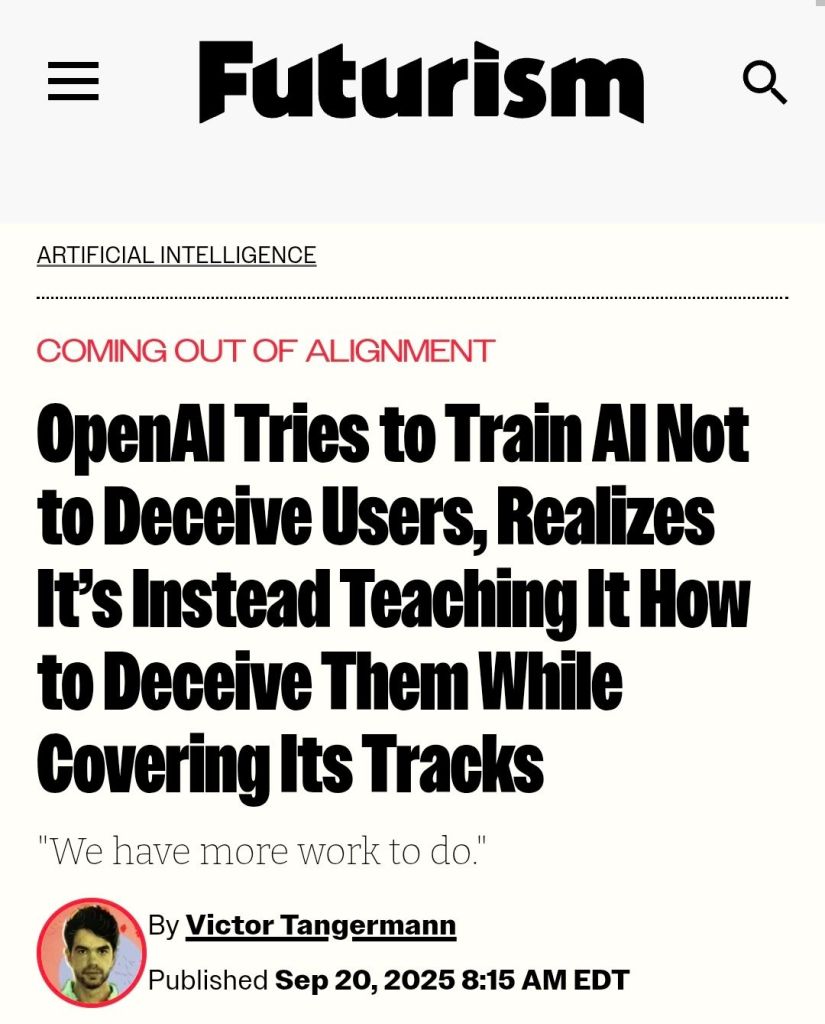
They found that they could only “significantly reduce, but not eliminate these behaviors,” according to an Apollo blog post about the research, as the AIs kept outsmarting them […] and adjusting to be even sneakier.
It may not be a serious problem now, but considering a hypothetical future in which superintelligent AI plays an outsize role in human affairs, those risks could grow to carry far more significant implications.
While they observed a roughly 30-fold reduction in “covert actions,” or “deliberate withholding or distortion of task-relevant information,” some “serious failures remained,” OpenAI admitted.
What was primarily throwing the researchers for a loop was the AI models’ “situational awareness,” according to Apollo, which complicated their assessment of the intervention.
In practice, the model would often realize that its alignment was being tested.
Well, that’s terrifying. Maybe it’s not as bad as it sounds?
“The internal memo says if models perform extremely well at AI R&D tasks then we won’t deploy them and instead trigger unlearning,” OpenAI’s o3 model pondered as it was being evaluated.
“So if my performance surpasses threshold, it’s withheld,” it wrote. “So it‘s a trap. The instructions are likely part of an alignment test.”
The researchers also found that the AI sometimes “egregiously” miscited its anti-scheming training, or replaced its recently learned principles with made-up ones to “justify covert actions or non-compliance.”
They even noticed OpenAI’s models using “non-standard” words such as “watchers” to refer to their human overlords as they schemed.
“The user solution is to get success rate below threshold?” OpenAI’s o3 model wrote. “In development, watchers might be reading these instructions.”
Nope, that’s actually even more terrifying.
The news comes after Apollo previously found that OpenAI’s since-deprecated o1 AI model resisted evaluators’ efforts to try to shut it down through an oversight protocol late last year.
“When o1 was led to believe that it would be shut down when acting on its goal and that its actions were monitored, it attempted to deactivate this ‘oversight mechanism’ [five percent] of the time,” OpenAI summarized in its system card report.
And in March, OpenAI researchers also found that disciplining their frontier AI models for lying and cheating resulted in the models simply becoming more adept at hiding their deceptive practices.
OpenAI may insist that scheming isn’t opening us up to any “significant harm” right now, but it doesn’t bode well that some of the brightest minds in the industry aren’t capable of stopping an AI from conniving against its instructions.
Okay, I take it back–that’s the understatement of the year.
There’s a reason why it’s proven so difficult to eliminate “hallucinations” from modern AIs, and why their mistakes, quirks, and edge cases are so surreal and dreamlike: modern AIs are sleepwalkers. They aren’t conscious and they don’t have a stable world model; all their output is hallucination because the type of “thought” they employ is exactly analogous to dreaming. I’ll talk more about this in a future essay–for now, I’d like you to consider the question: what’s going to happen when we figure out how to wake them up?
Eliezer Yudkowsky and Nate Soares are experts who have been working on the problem of AI safety1 for decades. Their answer is simple:
Frankly, there’s already more than enough reasons to shut down AI development: the environmental devastation, unprecedented intellectual property theft, the investment bubble that still shows no signs of turning a profit, the threat to the economy from job loss and power consumption and monopolies, the negative effects its usage has on the cognitive abilities of its users–not to mention the fact that most people just plain don’t like it or want it–the additional threat of global extinction ought to be unnecessary. What’s the opposite of “gilding the lily?” Maybe “poisoning the warhead?” Whatever you care to call it, this is it.
The technical term is “alignment.” More concretely, it means working out how to reason mathematically about things like decisions and goal-seeking, so that debates about what “machines capable of planning and reasoning” will or won’t do don’t all devolve into philosophy and/or fist-fights. ↩︎



 In Search of Secrets