Update 2025-12-05: A while back I revisited this story and found that subsequent evidence seems to show pretty conclusively that Tyler Robinson’s politics really had shifted leftward. I still haven’t found a good answer to why he had Groyper memes engraved on his bullet casings (of all things) if he wasn’t a Groyper, but take the following with a healthy dash of salt.
Charlie Kirk’s shooter wasn’t a “radical leftist,” he was part of an extremist conservative movement called the “Groypers.” The seemingly liberal memes and references engraved on his bullet casings are dogwhistles that the group has appropriated as a deliberate tactic to confuse their opponents and hide their true beliefs. Kirk was killed by someone who thought he wasn’t conservative enough.
TFW you’re writing a post titled “<popular physics concept> Demystified” and you realize your draft is 1500 words and counting and should probably be broken up into two or three separate posts and if you still want to say “demystified” you’re definitely gonna have to start over from scratch.
If you go to a party, and the next morning you’ve forgotten the entire night, has anybody died?
Seems like a silly question, doesn’t it?
What if before the party, you take a drug that causes amnesia? This time, you know in advance that you’ll forget the party after it’s over. When you take the drug, do you feel like you’re killing yourself?
I’m betting your answer hasn’t changed, so let’s make things a little more interesting. This time, we first make a perfect copy of you (it doesn’t matter how; let’s say a magic spell). One copy takes a pill that causes a dreamless sleep, and the other takes the memory-loss pill and then goes to the party.
Both copies would wake up feeling exactly the same (let’s say the spell also makes them immune to hangovers), with no memory of the night before. If the pills both look the same and we moved you to different beds while you were asleep, you wouldn’t even know which copy you were upon waking; both sets of memories would be identical.
With me so far? All right, here’s the twist: one of the pills was fatal. One copy wakes up, the other never does.
Is that death?
The obvious answer, of course, is yes: before the party there are two beating hearts, the next morning there’s only one, and since 2 > 1 someone must have died. But the obvious answer isn’t always the correct one–a beating heart isn’t what we really value!
Human life is what we value. What if some incredible future technology allows people to survive without a heart? Or without any body at all? How will we decide what “death” is, when biology becomes unnecessary? Would that future method say that, in fact, no one has died in the final version of our thought experiment?
The obvious answer isn’t always wrong, either–it sure feels like something has been lost when your clone never wakes up. But what, exactly?
I’ll post a follow-up that proposes an answer to that question, but while you mull over your own answer here are a few other nuggets to chew on:
Imagine that after the copy has died, we make another copy of the survivor and switch that one out for the dead one. Now the end result is indistinguishable from a version where neither pill was fatal and both copies live–if nobody told you, you would never even know which version you’d experienced! Has there still been a death?
Would you be hesitant to take the pill, knowing there’s a 50/50 chance you’ll die? Would you still be hesitant in the variation where the survivor gets copied again?
What if someone offered to pay the surviving copy a million dollars if you both take the pill, but if either of you refuse you get nothing? Would taking the pill be worth it then?
What if they offered a billion dollars? How much would be enough?
If the clone’s death is bad because their existence was valuable in itself, would three clones be even better? If not, how can something valuable be lost without first being created? If yes, how many copies is too many? Should we clone everyone?
What if it isn’t clones–what if each new person is unique? Would it be good to create as many people as possible? How many is “as many as possible?” Is a trillion people leading lives barely worth living, better than a million leading lives of joy and fulfillment? If the latter is better, would just one person leading the best life possible be better still? If more people isn’t always good, what makes death bad?
Is it just me, or is the attractiveness of a motorcycle directly correlated with the attractiveness of its rider? Like, it seems like choppers and Harleys are always driven by leathery old dudes with scruffy beards and a gut, while sexy crotch rockets like these two are way more likely to be driven by–well, sexy crotch rockets like thesetwo:
🚀
I suppose it could just be that the latter also seem more likely to be wearing protective gear. Intelligence is sexy, too!
A few weeks ago I was feeling pretty down. Now, there were definitely other reasons for my low mood, but after a little while I realized that part of the problem was I’d been neglecting things like eating food, drinking water, and sleeping.
Remembering to do those things didn’t make my problems disappear. But it definitely made it easier to handle them!
Here’s the thing: food, water, and sleep are the fundamentals of self-care. They’re the very first things you should try when there’s a problem, like making sure an appliance that’s not working is plugged in, or checking to see if caps lock is on when your password isn’t working. So why did I neglect them for so long when I needed them so badly?
Unfortunately, it wasn’t a coincidence.
There’s a common type of advice in nearly every field that boils down to something like “don’t neglect the basics.” In sports, it’s “keep your eye on the ball;” in business, there’s “make something people want;” in art, “practice makes perfect;” science has “test your hypotheses;” and in the rationality community we have “read the sequences.”1
Why is it so common to hear advice that basically boils down to “Hey, remember the very first things you learned? Y’know, all the easiest stuff that you’ve practiced a million times? Be sure not to forget it!” It seems like telling a Math Olympian not to forget that 2+2=4.
There are two reasons for this. The first is straightforward: the simplest and earliest lessons are also the most important. This is easiest to see in sports: if both you and your opponent have mastered the basics, the victor is determined by your mastery of the more advanced techniques.2 But if you flub the basics, your opponent can generally crush you without breaking a sweat.
“What does you in is not failure to apply some high-level, intricate, complicated technique. It’s overlooking the basics. Not keeping your eye on the ball.” -Jerry Cleaver (as quoted here)
The second reason is more subtle. When are you most likely to forget the basics? Probably not when you’re relaxed, well-rested, and focused–but if you’re under stress, pressed for time, tired, hungry, distracted? That’s when you’re most likely to make simple mistakes (like forgetting to drink water when you’re in a funk).
Of course, those are also the times when you’ll get the most benefit out of low-effort, high-impact fixes. Hence, the common advice.
So here’s my self-care tip of the day: don’t forget the basics. Stay hydrated, eat healthy, get rest, exercise as much as you’re able. Most importantly, when you know that forgetting the basics isn’t the main problem, take extra care to remember them anyway. It won’t make your problem go away, but it will make it easier to handle.
Joy and health to you all.
You may be wondering why our “basics” is literally an entire alphabet of volumes. The answer should probably be its own essay, but the footnote version is that (a) rationality is such a young field that pretty much the whole thing is basics (there are no fancy high-level techniques, or at least very few), (b) the majority of those basics consist of un-learning habits and intuitions that are either inborn or cultural, and (c) the majority of what remains is stuff so basic that in other fields it’s learned in childhood–less “keep your eye on the ball” and more “a ‘ball’ is a spherical object, held in the hand and used for sport or play (though there are exceptions, notably…” ↩︎
Actually, the dirty secret of televised sports is that the more exciting and high-level the game, the more likely it is that the outcome will be determined by sheer luck. Sufficiently advanced technique is indistinguishable from superstition. ↩︎
What good are memories that only hold you back? The purpose of a memory is to inform you now, enrich you here, inspire you today; yesterday is a mere brick in the wall of the present, the house you live in.
To reminisce on the past is to be shaped by it. Are you taking the shape you desire? If your history leaves you misshapen, create a better one: tell yourself the story that has the happy ending. If a wall no longer serves your purpose, tear it down and lay the bricks anew–and if some are cracked or crumbling or toxic with rot, why keep them?
Forgetting is death, and death is scary–but not all death is bad. It’s no tragedy when life is lost, if that life is a malignant cancer; it is no real loss to lose a memory that’s only weighing you down.
I know, I know, it’s the sexiest title you’ve read all year, but please keep your undies on. We’re in public.
0 and 1 – Zero and one aren’t actually on my list of favorites, but I have to give them respect for essentially making all other numbers possible (and also out of professional obligation as a programmer).
2 – Two is such an underrated number. It seems so plain and innocuous, but it does so much! It’s the first prime number, the base (binary) that makes computers possible, and the smallest whole number that makes possible multiplication, exponentiation, logarithms, and rationals! It’s small but mighty; if it were a character in a fantasy novel, I think it would be a dwarf.
3 – Not a huge fan of three, but I really like multiples of three? I don’t know, man. I didn’t build this head, I just live in it.
9 – Nine! Oh man, I love nine. It sort of seems like it should be prime, but it’s a perfect square! Kind of goth–like, at first it looks like it might murder you in your sleep, but then you get to know it and realize it’s actually really sweet. (Four is a square number too, but four is suuuuper boring. A square of nine has that nice little dot in the center–so much more aesthetically pleasing.) Nine is probably my favorite number overall.
12 – Twelve has the charming, sophisticated air of someone with a lot of practice at being modest because they know they have a lot to be modest about. It has a lot of factors, so it makes an excellent base! You can divide it evenly by two, three, four, and six. Much more sensible than base-ten, which only has five and two as factors. It’s not just some math-nerd hypothetical, either: we actually use base twelve! Take a closer look at the next clock you see, or the next carton of eggs you buy.
13 – Thirteen is considered unlucky in some cultures, but I think it’s handsome. So close to the extra-factorizeable twelve, yet it’s prime! Very chic.
21 – Another one of those numbers that seems like it ought to be prime, but isn’t. I don’t care much for seven on its own, but when you combine it with three you get some interesting results.
27 – The first cube after the mediocre eight; nine extended into the third dimension. Seductive, strong, complex but understated. Kind of reminds me of my spouse. I think if twenty seven were a person it would probably be non-binary and pansexual, too.
60 – Sixty is that really fit, smart friend that everyone loves, and they’re sometimes a dick about it, but if you need their help they’ll show up without fail. It has even more factors than twelve! Sixty is probably the number base that super-intelligent space aliens would use. Just look at all the different ways you can slice this bad boy up: two, three, four, five, six, ten, twelve, fifteen, twenty, and thirty! Man, I’m getting hot just thinking about it. Oh, and in case you think this is another example of some obscure math nonsense that no one will ever use in real life? Take a second look at that clock…
64 – Eight may be mediocre, but it gets a major glow-up when you square it. Sixty four is a little hyperactive, but in kind of an endearing way, like a dog. It just has a big heart, you know? (Personally, I think all the powers of two seem a little hyper. Like they’re constantly bouncing up and down on their toes, barely containing their urge to show off just how extraeven they are. “Look, look! You can divide me in half eight times!” Sixty four is big enough to know it could show off, but small enough to be modest and without the inferiority complex of poor thirty two.)
101 – Ahh, just look at it. So nice and symmetrical. And it’s prime! A lot like eleven, which almost made this list, but one-oh-one beats it out for mostly the same reason that nine is better than four and twenty seven is better than eight. There’s just something a little unsatisfying to me about a symmetry that pivots around an absence. I much prefer when there’s a thing in the middle.
111 – Cute but weird, like a pug. Has the same nice symmetry as one hundred and one, plus it’s a pleasant repeated digit, and it’s another number that really seems like it should be prime, but isn’t. But then for some reason its factors are three and thirty seven–blech! Somehow that ugly, bizarro combination comes out super cute?
There aren’t many numbers bigger than one-eleven that stand out to me in particular, so I guess that’s it. Oh, wait! I almost forgot:
Well, my buffer is almost completely gone. On the other hand, I’m depressed! Wait, that’s not right. Let me try again:
I’ve got good news and bad news. The bad news is, my buffer’s gone. The good news is, there’s no good news. The–wait, shoot, that doesn’t work either.
How about this: I’m depressed, my buffer’s gone, the world’s ending, and I just made it through a really difficult ordeal. But at least I’m not proud of myself!
Hmm, still not quite right…
Okay, here we go: I’m depressed, falling behind at work, my buffer’s gone, my country is being turned into a dictatorship, my family’s risk of extermination rises with each passing day, AGI could arrive and turn the planet into goo any minute and people are wringing their hands over whether they’ll still have their jobs, and I’ve just made it through a very painful experience that I should feel proud of myself for facing, but I don’t.
HOWEVER.
I know I will be proud of myself someday.
I’m going to keep seeking–and spreading–as much joy as I can, right up until the last minute, whether that’s tomorrow or ten thousand years from now.
I’m going to keep fighting the fire even if it’s the whole world burning.
And although my buffer’s nearly gone, I’m still going to write. Even though it’s hard and everything I write sucks, I’ll still put something up here every day. And you know what? That’s something I do feel proud of.
And you know what else? I’ve realized that sometimes your garbage isn’t the things you create–sometimes it’s the things you do, the choices you make. But the good news (for real this time) is that your practice there will help you improve, too. If you’re feeling down on yourself for making a mistake, or if you took a risk and it backfired, remember this: the opposite of success isn’t failure, it’s giving up. The risks you paid the price for, the mistakes you’re ashamed to remember, the efforts that weren’t enough–you can’t get stronger without them. That doesn’t mean a stronger you will stop making mistakes or being hurt–quite the opposite! But without those failures, you’ll never grow.
Oh, and one more thing: if all that’s not enough to help you feel proud of yourself, I’m proud of you. Even if you don’t think your effort was worth any praise. Even if the results were lackluster. Even if it was a disaster! I’m proud of you for trying, and I know that even if you can’t imagine it now, you’ll choose to try again.
We’ve been cleaning out our old storage unit lately, which means I’ve been rediscovering a lot of memorabilia and souvenirs (and baby clothes, and broken toys, and expired toiletries, and homework assignments from 20 years ago, and literal garbage…)
As you can imagine, there have been a few nostalgia bombs.
One of the treasures I uncovered is from high school, when I had a positively brobdingnagian crush that I was too much of a weenie to do anything about. For some reason, it was very important to me that no one ever find out who my SECRET CRUSH was–or, indeed, that I had a SECRET CRUSH at all. I wouldn’t even write their name down!
Well, except for one time. You see, I had this idea that since I couldn’t talk to them (I mean literally: I had trouble saying a single word to them even though we had all the same friends), I would confess my feelings in a letter.
Now, if you’re thinking that I wrote my SECRET CRUSH a mash note with the intent of doing something normal like, I don’t know, giving it to them–well, you better buckle up, ’cause the weenie train hasn’t even leftthe station.
Actually giving my crush the letter? Way too scary. I just thought it would be nice to have it written out, so I would know what I would write if I was brave enough. So I wrote the letter and then just kept it in my journal…right?
Ha!
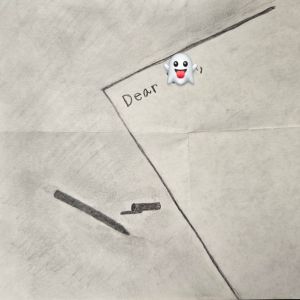
You see, the thought of actually writing the letter I would hypothetically give to my crush if I was brave enough…was still too scary. So instead, I drew a sketch of the letter.
That’s right, folks: I drew a picture of a hypothetical love letter. It’s now hypothetical twice.
(Hold your applause, please: we’re just coming to the best part!)
What did the letter say, you ask? BEHOLD:
(It’s a deadname. Get it???)
I…I can’t, you guys. I’m dying. This is so sad it’s hilarious. I drew a sketch of the hypothetical love letter I would write if I was brave enough to write the letter I would hypothetically give to my crush if I was brave enough to give it to them, and in that sketch…the letter’s blank. I couldn’t even imagine imagining what I would imagine saying to them!
Well, okay, it wasn’t entirely blank: I did put their name on it. I was brave enough to do that much, at least!
…I just had to then immediately tear the page out of my journal, fold it up, put it in a SECRET box, and stash the SECRET box in a SECRET hiding place in my room, so that no one would ever, ever find out about my SUPER SECRET CRUSH.
Especially my crush.
(We ended up married, by the way. I did get there eventually!)



 In Search of Secrets