
Can you imagine if Dr. Seuss had been a political cartoonist during WWII? Don’t you wish you could see what those cartoons might have looked like? Well, I have good news:
HE WAS ACTUALLY A POLITICAL CARTOONIST DURING WWII
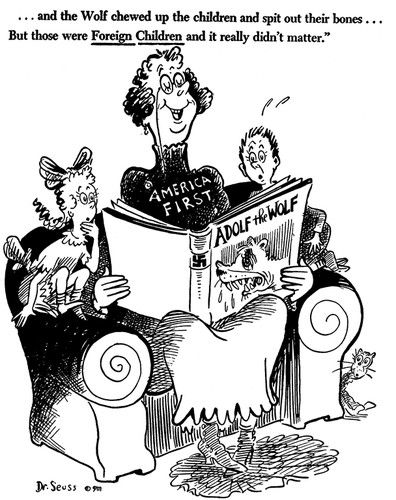
Can you imagine if Dr. Seuss had been a political cartoonist during WWII? Don’t you wish you could see what those cartoons might have looked like? Well, I have good news:
HE WAS ACTUALLY A POLITICAL CARTOONIST DURING WWII
Filed under Microblogging
The trouble about fighting for human freedom, is that you have to spend much of your life defending sons-of-b*tches; for oppressive laws are always aimed at them originally, and oppression must be stopped in the beginning if it is to be stopped at all.
Everyone knows that censorship is bad. That’s why nobody calls it censorship unless it’s their opponents doing it–they’ll call it something like “defending truth” or “protecting minorities” instead.
I’ve seen way too many fellow liberals argue for the criminalization of pornography and/or sex work. (This isn’t what the whole post is about, but I gotta start somewhere.) When it’s phrased in terms of protecting women and children, it’s hard to argue against. No feminist wants to defend the toxic and degrading attitudes towards sex and women that mainstream pornography models, and nobody with a grain of moral integrity or social self-preservation wants to be seen as encouraging slavery, or the abuse and exploitation of women and minorities. But I worry, now that the ruling faction has made criminalizing porn seem actually doable, that those friends might miss the bigger picture.
Make no mistake: the recent crackdowns on adult content–delisting games from Steam and itch.io, stricter age verification on both adult and all-ages websites, increased pressure on payment processors to vet (read: abandon) vendors of adult media, etc.–aren’t really about protecting children or women. They’re about criminalizing sexuality.
Going after pedophiles, pimps, and perverts is just an excuse. As you’re undoubtedly aware, they’re also going after trans people, homosexuals and queers, scientific research on sex, abortion protections, and the sex workers themselves. Do you think they’re going to stop there? Letting them tamp down the fringes of society just shrinks the fringe. Promiscuity. Fetishists. Premarital sex. Divorce. Domestic abuse protections, including spousal rape. Art depicting sexuality of any kind. Birth control. It’s not paranoia, it’s spelled out in black-and-white in the Project 2025 playbook, which our current administration has been following almost to the letter.
(This is where I transition from talking about porn to talking about the kinds of left-wing censorship people get in real fights over.)
Humans are political animals, and it’s natural–commendable, even!–to want to silence bullies who are causing legitimate harm. But a person’s capacity for harm doesn’t come from their words alone, it comes from the power others give them. A bully with more power than you can’t be silenced by force, and if you silence someone with less power than you, guess what: you’re the bully.
Yes, really.
If someone is causing harm, by all means work to put a stop to it–but never forget that as a human being, you will overestimate how justified you are in silencing–not just stopping–your political opponents. Remove their ability to cause harm, not their ability to disseminate their beliefs.
Restrictions on freedom of speech are the canary in the coal mine of fascist takeovers. “Cancel culture” was a far sight from fascism, but it shifted the Overton window on what sort of political tactics were deemed acceptable. Do you still believe (if you ever did) that it’s okay to fire someone for voicing a belief that’s unrelated to their job, not about a specific person, in their free time and on their own channels? Because the exact same justifications are being used now to harass and persecute critics of the government, to wipe out entire federal departments performing critical work, to threaten free journalism, and more. If you feel reluctant to defend free speech when the people speaking are gross, evil, embarrassing, assholes, wrong, whatever–please, please get over it. It is not, and never has been, about them. Something much bigger is at stake.
Freedom of speech is the irreducible foundation of any free government. We all implicitly understand its importance, even if we never put words to it. So much so that even the fascists will claim “free speech” as a justification for their actions–and many of them believe it, too! Which just goes to show how difficult a principle it is to actually stick to.
Part of the difficulty, of course, is that a lot of beliefs really will cause harm if acted on. And of course we want to stop people from spreading these harmful beliefs! It really, truly feels like the right thing to do, deep down in the bottom of your soul. But liberalism (and by “liberalism” I don’t mean “left-leaning ideology” or something, I mean the miraculous civil-war-prevention technology that was both the product and engine of the Enlightenment) is more delicate and counterintuitive than most self-proclaimed liberals realize. If you stop critically examining your urge to stifle harmful speech, you throw sand into the gears of a machine that’s saved the lives of nations.
Freedom of speech and belief is amendment #1 for a reason. Never hesitate to defend the inalienable rights of others–not even sons-of-b*tches.
It’s not them you’re really defending.
Filed under Essays
When our daughter first started talking, we began asking her what she wanted to be called. My spouse and I had decided that if she wanted to pick a name other than the one we gave her, that was her right.
At first, she experimented quite a bit, and as you might imagine there were some…questionable choices. It was embarrassing at times–I wrote “Car Racecar” on more than one official school form–but we trusted that as she learned and matured, those childish phases would pass. Sure enough, she eventually settled on a lovely, sensible name (one my spouse and I, by pure coincidence, had considered ourselves!) and she’s been happy with it ever since.
It’s unusual, I admit. It’s not a path I would recommend for every family. But I believe it was the right decision for us, and for her.
Every once in a while, we would also ask her what pronouns she wanted to be called. We’d frame the question in the same way we were phrasing questions about her name: did she want us to keep using the one we gave her when she was born, or did she want to be called something different? Just like with her name, there was a bit of experimentation at first, and just like with her name we trusted that if it were a phase or a mistake, she would grow out of it on her own. Long before she settled on a name, she was confident that yes, she really did want to be called “she,” “girl,” “daughter,” and so on. That was about five years ago.
It had been a while since we’d checked in on her decision, so I recently reminded her that she could always tell us if she ever changed her mind. She responded, sounding quite confused, “Why do you think I would change my mind?” Why, indeed. Her girlhood is as self-evident to her as the color of her hair.
Her birth certificate is marked with an “M.”
Many people would be outraged to hear this. They would say we are enabling a delusion or a mental illness. Our current President, in a proclamation issued for National Child Abuse Prevention Month, claimed that so-called gender ideology is “one of the most prevalent forms of child abuse” in the country. Gender extremists, he said, are telling children “the devastating lie that they are trapped in the wrong body.”
Now, I could point out that under-eighteen rape victims outnumber trans kids nearly thirty to one, but that’s ultimately a quibble. All forms of abuse should be prevented, regardless of their prevalence. The real problem with this claim is the assumption that if my daughter is trans, it must be because I’m telling her she’s “trapped in the wrong body.”
Guess what? My daughter loves her body. She loves climbing and running and playing outdoors, she loves being strong, she loves being fast (the second-fastest girl in her class!) The only time she has expressed any distress over her biology was when she came home from school one day and told me she wished her voice were higher. When I asked her why, she said it was because a classmate had told her she “didn’t sound like a girl.”
So it’s true, there are people saying my daughter’s body is wrong–but it is not the people calling her by her chosen name and gender. It’s the people who would tell her that, because of her body, she doesn’t count as a “real” girl; that because she was born with a certain biology, her girlhood is fake, a delusion, a lie. When trans kids are told over and over again that their bodies are the reason their transness is rejected, is it any wonder so many of them end up feeling trapped? I can’t help but wonder: if more people believed, as my daughter still does, that a girl with a penis is perfectly unremarkable…would fewer trans people feel a need for surgeries and hormones? Would more of them be happy with their bodies, if we didn’t insist that one’s gender and biology “match?”
Someday soon, I know my daughter will ask me if she can play sports with her friends. It would be nice to know I’ll be able to tell her “yes”–but that’s not the question that really keeps me up at night. The real question is: will my daughter be allowed to be my daughter? When she tells people she is a girl, will she be heard and respected, or will she be harassed, ignored, bullied, and ridiculed? Or worse, will she be stolen away from the loving family she was born into under the pretense that using the “wrong” words to address her is abuse?
The President ended his proclamation by saying “my message to every American child is simple: you are perfect exactly the way God made you.” The part he didn’t say, of course, was “…unless you were made intersex, trans, queer, brown, neurodivergent, or just generally Different. Those kids need to try harder to be perfect, like the rest of us.”
Who’s telling kids they’re in the wrong bodies, again?
Filed under Essays
Observations:
Conclusion: even if we assume Rightists and Leftists are about equally likely (on average) to be in the wrong about any particular issue at any particular point in time, we would still expect societies as a whole to gradually shift Leftward–which is, in fact, what history shows.
Thoughts?
Filed under Essays, Microblogging
To everybody who thinks “not being into politics” makes you neutral, Deltarune would like to have a word with you:
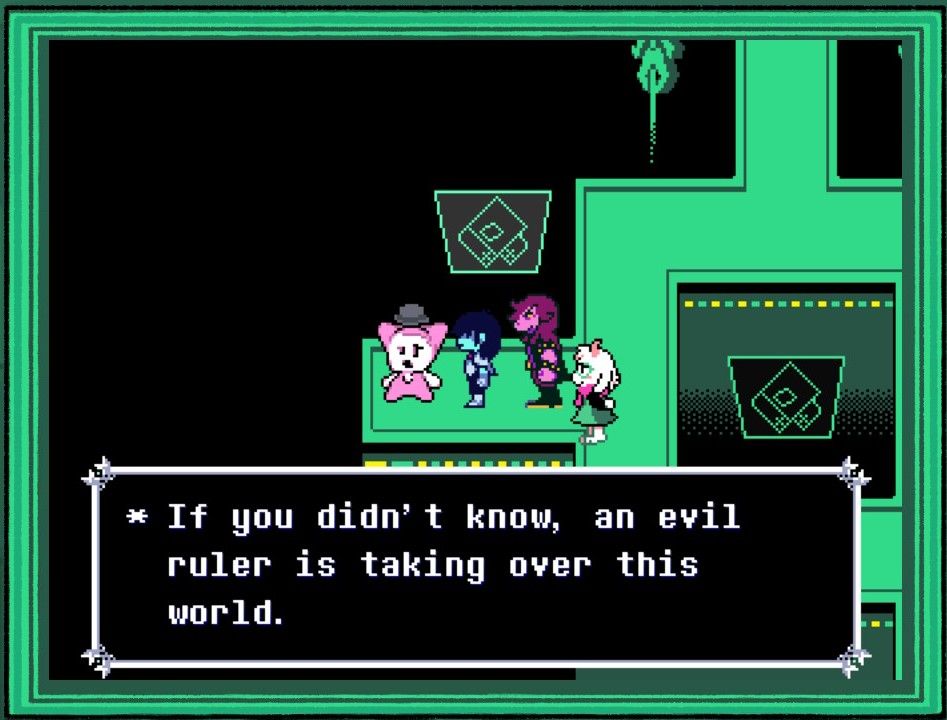
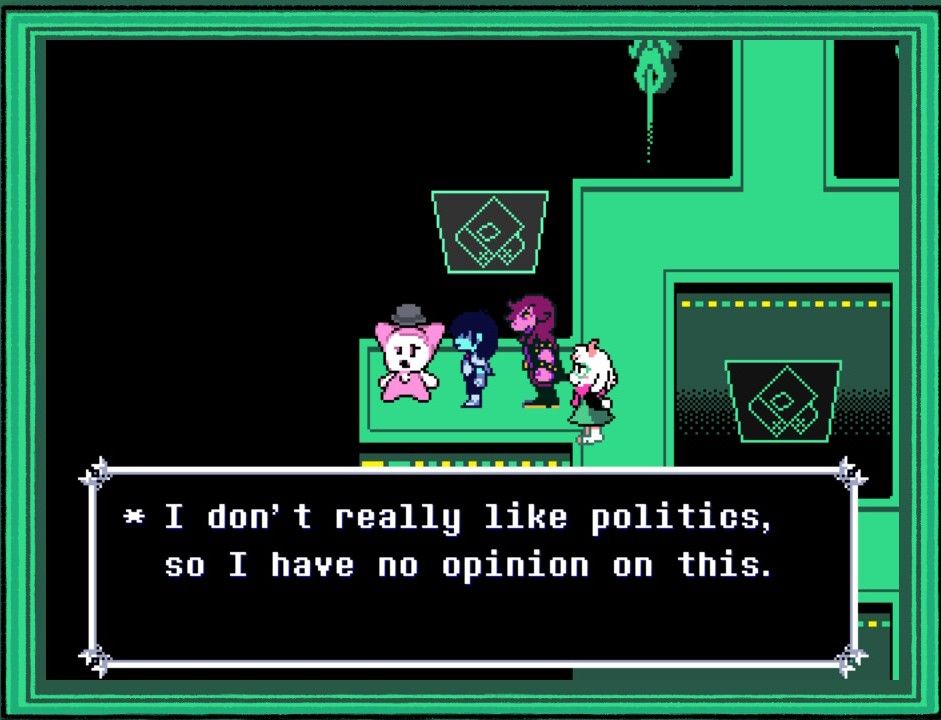
Filed under Microblogging

Please don’t use “lonely” to mock and insult people. No, not even N*zis. Companionship is a fundamental human need, right along with food, water, shelter, and safety. When people steryotype “loneliness” as a defining feature of disgusting incels, they alienate potential allies and push vulnerable people who are genuinely suffering into the arms of a toxic culture that exploits their suffering to perpetuate misogyny, classism, and white supremacy.
“Lonely” is not a character flaw and shouldn’t be used as an insult. If you wouldn’t use “autistic” or “triggered” or “sexless” or “depressed” as an insult, don’t use “lonely” as one either. None of those things make a person good or bad!
“N*zi,” on the other hand, is a character flaw. That one’s a great insult! “Incel” is pretty good, too! Just stick with those, please!
Filed under Essays, Microblogging
Running low on spoons at the moment. I was going to have my “comments are back” announcement be today’s post, but then Chris Ferdinandi, one of my favorite bloggers, wrote a post about “Spreading Joy” and I had to share. Here’s an excerpt:
Yesterday, I found myself being extra friendly even when the guy behind the deli counter at the market was standoffish at the start.
He opened up eventually.
I told a woman I loved her anchor-pattern dress (because I love anchors and really did!), and found out she was headed to a wedding on a boat that afternoon, and was there to pick up a cake!
I’ve gotten so jaded and angry (because there’s a lot to be angry at) that I’d kind of forgotten how to have real, genuine joy.
It was a good reminder that I need to hold on to that, because fascism hates joy and spreading it is anti-fasc.
There’s lots more great reads on his daily developer tips page. Most of them are programming-related, but quite a few of them (like this one) aren’t. Go check it out!
Filed under Reviews
It’s a bumper sticker I see now and then. Funny, right? Ha ha, let’s all laugh at the idea that your “identity” can change what’s under the hood.
Only…what if what’s under the hood actually was a Prius engine? Would it be such a stretch then to say your truck ought to be treated like one? That you should be entitled to the same tax breaks and emissions exemptions and parking privileges as any other hybrid?
You might be thinking, “Sure, but people aren’t cars–you can’t just swap parts between them the way you could an engine or suspension!” And it’s true, people aren’t cars: men and women are much more similar to each other than trucks and cars. Unlike them, we aren’t designed and built from the top-down, we’re grown from the bottom-up. We all start from the same two cells, and we all spend the first few days and weeks of our lives looking pretty much the same. Even our genitals are all identical at first! In fact, there are a number of ways male and female “parts” can get mixed up at all stages of development.
Some “mix-ups” are so small as to be barely noticeable: a woman with unusually high testosterone levels or muscle tone, or a man with wider-than-average hips. Others are harder or impossible to ignore: a woman with facial hair, a man with breasts.
Even the venerated “sex chromosomes” are not definitive: there are XY people who can conceive and give birth, and XX people with penises and functional sperm. Not to mention all the other possible karyotypes such as XXY, Xo, XYY, and more.
Given everything that can get “mixed-up” and all the different ways in which a person might not fit the “male” or “female” archetypes, is it really that much of a stretch to suppose that a person might be born with a typically male body, but a female mind? (Or vice versa?)
There is one other important way that cars and people are different: if you claimed that your truck had a Prius engine, we could open the hood and check. But, for better and worse, we can’t simply pop open the hood of someone’s mind and see what’s in there. With rare and limited exceptions, when someone makes a claim about their own mind, we have no ethical choice but to take their word for it.
Identity is complex. Not all of it is determined by biology; there are parts of your identity that you can choose. But being trans, like being gay, doesn’t seem to be one of them. Without exception, every trans person I’ve heard talk about it has described realizing they were trans as a discovery, not a decision: looking back on their past and seeing that they had, in fact, been trans the whole time.
If you’d owned a truck for years that was underpowered but strangely quiet and fuel-efficient, and one day you opened the hood for the first time and discovered it had a hybrid engine… Well, maybe that bumper sticker wouldn’t seem like such a joke anymore.
Filed under Essays

 In Search of Secrets