My spouse: “I’m probably biased, but I genuinely think we have two of the cutest dogs in the world.”
Me: “You are absolutely biased, and also correct.”
My spouse: “I’m probably biased, but I genuinely think we have two of the cutest dogs in the world.”
Me: “You are absolutely biased, and also correct.”
Filed under Microblogging
As I’ve previously mentioned, I have ADHD. I didn’t receive an official diagnosis until just a few years ago. This is because I’d completely dismissed the possibility for decades, for two main reasons:
So what changed my mind? Coincidentally, it was also two main things:
More than that, in fact: in the right circumstances we’re able to pay better attention than neurotypicals. The term for this ability is “hyperfocus”–a state of mind closely related to flow that allows us (or, more often, compels us) to concentrate on some extremely specific detail, problem, or idea, to the exclusion of all else. When someone with ADHD looks like they’re “zoning out,” they’re probably not just staring into space–much more likely, they’re staring into their own heads, focusing intently on some idea or thought that’s developing at breakneck speed.
People with ADHD do not “lack attention.” We have attention in spades. What we lack is the ability to consciously direct that attention.
(This is one reason why meditation can be so helpful for those with ADHD–and also why meditation seems so difficult to us at first: it helps train the mental muscles that control our focus.)
Hyperfocus can be frustrating, but it can also be a huge asset. When people with ADHD are able to work on the things that interest us, we can be almost superhumanly productive. On the other hand, if we have to work on something that doesn’t automatically engage us, just keeping ourselves from wandering off can quickly use up all our spoons–sometimes before we’ve actually gotten anything done!
People with ADHD aren’t lazy, we don’t have a poor work ethic, and we’re not “wasting our potential.” That amazing focus and productivity can’t be switched on at will. Our potential often is wasted–but in many cases, it’s only because we’re required to survive in a world built around abilities we don’t have, while the abilities we do have are forced onto the sidelines: as hobbies, second jobs, and fantasies.
(Like so many other things, a Universal Basic Income could help a lot with this problem!)
Filed under Essays
Undertale.
Under. Tale.
Under, like…underground. Like in a cave.
Tale, like…a story.
An underground story.
A cave story, if you will.
…
HOW DID IT TAKE ME TEN YEARS TO GET THAT REFERENCE???
Filed under Microblogging
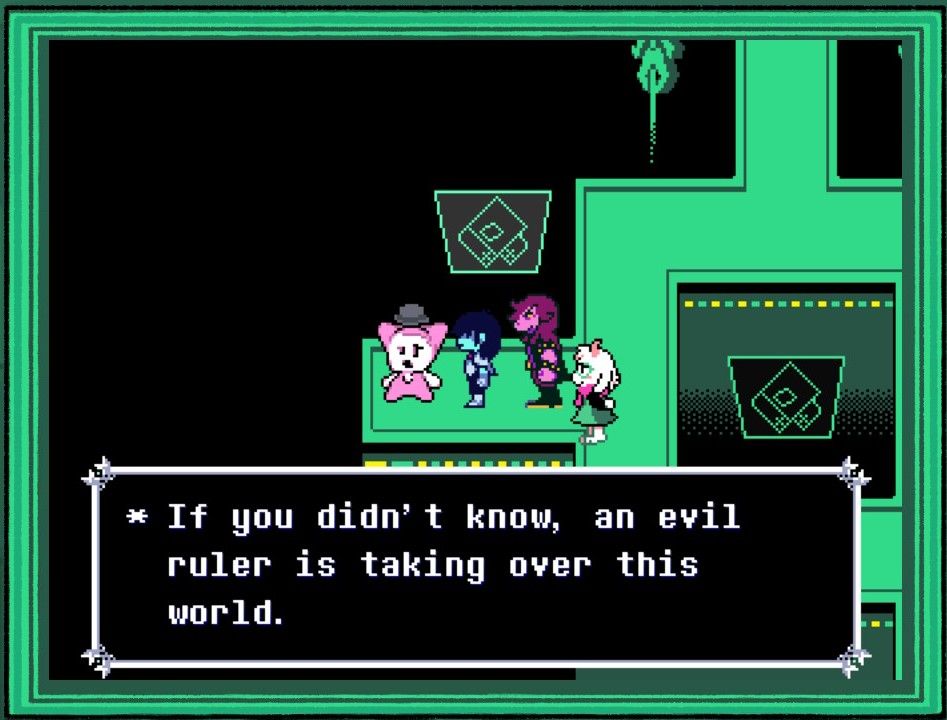
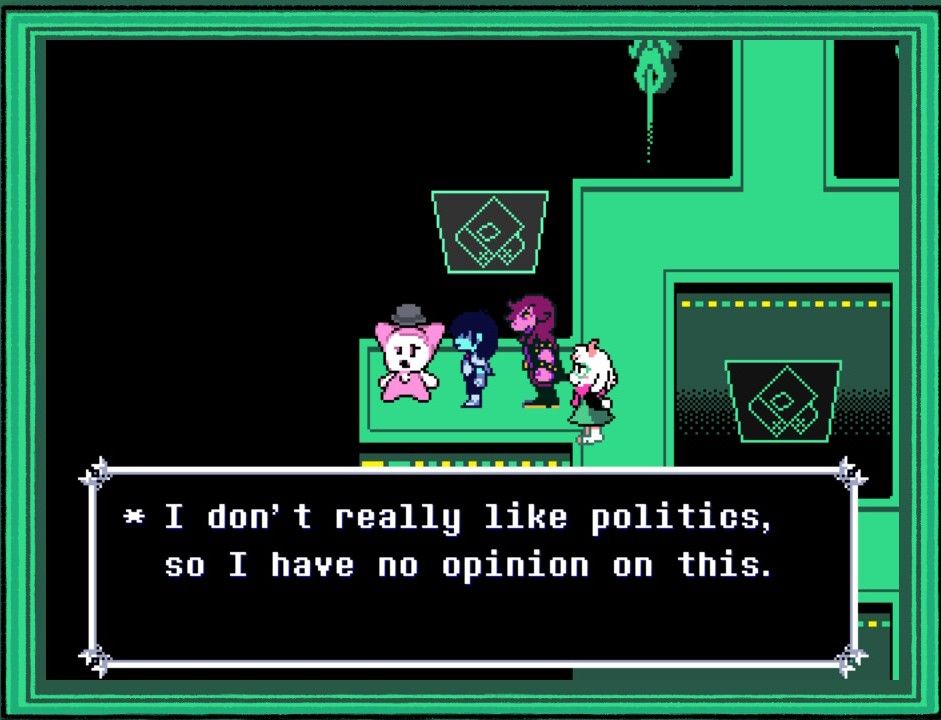
To everybody who thinks “not being into politics” makes you neutral, Deltarune would like to have a word with you:


Filed under Microblogging
Content note: minor spoilers and plot speculation for Deltarune
Continue readingFiled under Reviews

(No one else taught her this trick, by the way. She came up with it on her own.)
Filed under Microblogging
Over the holidays, I finally got fully caught up on the dishes for the first time in…um, let’s just say “a while.” This led to a very interesting realization! Seeing the counter finally clean and empty…made me anxious.
Why? Was that?? My reaction???
It definitely wasn’t for any conscious reason. My best guess is, seeing the counter clean suddenly made me feel pressured to keep it that way. Historically, I often respond to high expectations (from myself or others) by unconsciously self-handicapping, which would track with feeling anxious at the prospect of increased expectations.
This time, I’ve so far been able to redirect my anxiety into re-training my emotional response, so that seeing the clean counter feels more like a satisfying reward and less like a failed obligation hovering over my head like the sword of Damocles.
(I have done this, in part, by setting a rule for myself that every time I eat a cookie I also have to do some dishes.)
I’m hopeful that knowing what that feeling is and where it comes from will help me identify it in other contexts so I can re-train myself in those areas, too. I’ll let you know how it goes!
Filed under My Life
I never cared much for odes before. Maybe that’s only because all the odes I’d been exposed to were Keats’, and Keats’ odes seem a little…understated. Even melancholy, at times.
Now that I’ve learned more about the form (and now that I’m trying to write one of my own), that seems ridiculous. As I understand it, the whole point of an ode is to be over-the-top in your praise, to exult your subject, to be effusive, to be–well, a bit wild.
Maybe I’m not sophisticated enough to tell (or maybe I’ve just been reading all the wrong ones), but I’ve never seen a poem by Keats I would describe as “wild.”
I, on the other hand, am having so much fun being over-the-top.
I’d never realized before how much work I’m constantly putting into holding back when communicating strong feelings. Even in My Top Ten Rains, a poem specifically about feelings, I worked very hard to be understated: to show more than tell, to rely on the reader’s imagination to reconstruct my emotions from the blueprints I’d left on the page, rather than handing them over fully-formed.
And I think, for that piece, it was the right decision! I wanted the mood to be dreamlike, stream-of-consciousness; I wanted the reader to be able to imagine themselves in my place; I wanted them to actually feel some of those emotions rather than just reading about them. Even though the poem is about my own experiences, I didn’t want my ego (in either sense of the word) to be the main focus.
But ego is intrinsic to an ode! It’s not your opinion I’m trying to convey, it’s mine–with all the subjectivity, quirks, and uniquenesses that come with it…and it turns out part of that uniqueness is an intensity I hadn’t even realized I’d been concealing.
As a grown-up (and especially as a man), you’re not supposed to have strong feelings, let alone show them. But strong emotions aren’t wrong–in either the moral or epistemic sense.
Becoming more rational—arriving at better estimates of how-the-world-is—can diminish feelings or intensify them. Sometimes we run away from strong feelings by denying the facts, by flinching away from the view of the world that gave rise to the powerful emotion. If so, then as you study the skills of rationality and train yourself not to deny facts, your feelings will become stronger.
-Eliezer Yudkowsky, Feeling Rational
Of course, it’s still important not to overwhelm the people around you, especially when those strong feelings are about them. Luckily, this particular ode isn’t about a person, so I haven’t been holding back at all. It’s exhilarating!
…I should add that none of this means the poem will be any good. Don’t get your hopes up. But even if this ends up being the worst ode I ever write, I don’t think it will be the last.
You might be tired of hearing it by now. If so, I apologize. It’s just something I have a really hard time remembering.
I’ve been sticking to my daily schedule so far–and I’m really proud of myself for that!–but there’s a whole lot of half-finished posts piling up in my “drafts” queue and that feels like a bad sign. Microblogging has been great, and I’m going to continue doing it, but I think I need a bit of a nudge to actually finish more of the harder, long-form pieces. So here’s my resolution: at least one long-form post per week.
I expect I’ll put most of them up on Saturday, but that won’t be a hard-and-fast rule. I’d like to give myself a bit of extra time to start with, so I’m not going to. (Ha! Take that, me!) Expect a new long-form post by the end of this week.
(“Long-form” might be a bit misleading. The idea is simply to finish more of what I start; if I decide an idea doesn’t need more than a few paragraphs to be complete, that’s a win!)
Happy new year!