
So… Do any of you know what the market is like right now for skinny, 37-year-old, slightly-queer camboys? Asking for a friend.
Design So Bad It’s Gaslighting
So there I am, reading someone else’s post on WordPress. I get to the bottom and start looking for the “like” button because I did, in fact, like it. I can see it’s been “liked” by about a hundred other people. I can even see which ones! And I can see that I’m logged in, so that shouldn’t be a problem.
And yet, there is no “like” button to be seen–no star, no heart, no thumbs-up, nothing. I look up. I look down. I look from side to side. It’s not anywhere!
I’m not sure if it’s me or the UI, but at least one of us is absolutely moronic.
Filed under Microblogging
Millennial Problems
I’ve gotten used to seemingly innocuous things making me feel old, but for some reason learning that the mayor-elect of New York City is younger than me hit especially hard.

Filed under Microblogging
Voces Populi
The town my family lives in has pros and cons.
On the plus side, the scenery is gorgeous. It’s a small town right below one of the tallest mountains in the country. The weather is practically always sunny, even in winter, and there are multiple lovely parks in walking distance.
A lot of the town’s business comes from tourists, so it also has a charming and vibrant main street with an unusually high concentration of coffee shops for a town its size. Really good coffee shops–there’s one in particular that sells some of the best pastries I’ve ever had, including sumptuous homemade pop-tarts.
Every resident we’ve talked to so far has been friendly and helpful, especially the staff at our kids’ school (for whom we are extremely grateful). There’s even a surprisingly large liberal and queer presence, although the town as a whole is pretty conservative–we even had our own local Pride event!
On the minus side, well…like I said, the town is pretty conservative. The district school board, for example, has officially “decreed” that there are only two genders and that they are fixed from conception, and the town’s elections skew heavily Republican. Pickups with Trump bumper stickers are everywhere.
It’s also a very long way from my office, and while the scenery helps make the drive itself bearable, it still means too much money spent on gas and not enough time spent with my family.
The weather is also something of a double-edged sword–the thin atmosphere means the summer sun can make an 80-degree day feel like 100, while the winters alternate between frigid (often snow-packed) and weirdly warm. Deer, ice, fog, and flash floods are all potential road hazards–sometimes in the same day!
On the whole it’s a lovely place to live–at least for now–and we mostly knew what we were getting into when we moved. There have only been a handful of surprises, most of them pleasant.
By far the most unexpectedly pleasant surprise has been the local newspaper, which we find stuffed in our PO box about twice a month. It’s been strangely empowering just knowing more about what’s happening in the town, political and otherwise. It’s how we found out about the local Pride event, and how we decided who to vote for in Tuesday’s election (there were three open seats on the school board).
Even more surprising than the articles, however, have been the letters to the editor.
As I said, it’s a conservative town, so the letters to the editor contain their fair share of MAGAs, transphobes, and apologists. That being said, the discourse is mostly civil, and there have been a much broader range of views than I expected. It’s been heartening, for example, to see more than one staunch conservative condemning Trump and his actions along with the liberal and moderate voices, and there are many letters that share useful information on purely local issues (like the aforementioned school board’s activities).
Most surprising of all, however, have been the letters that aren’t really about politics at all, the ones that are just about lived experiences. Emotions, thoughts, and memories shared honestly; not as rhetoric or argument, but as simple communication. Sometimes it’s a plain “thank you” or “congratulations,” other times it’s more complex, but in each case the feeling is of neighbors reaching out to each other through a sense of community, not competition, fear, or anger. Not the Voice of the People, just…people.
People, and their voices.
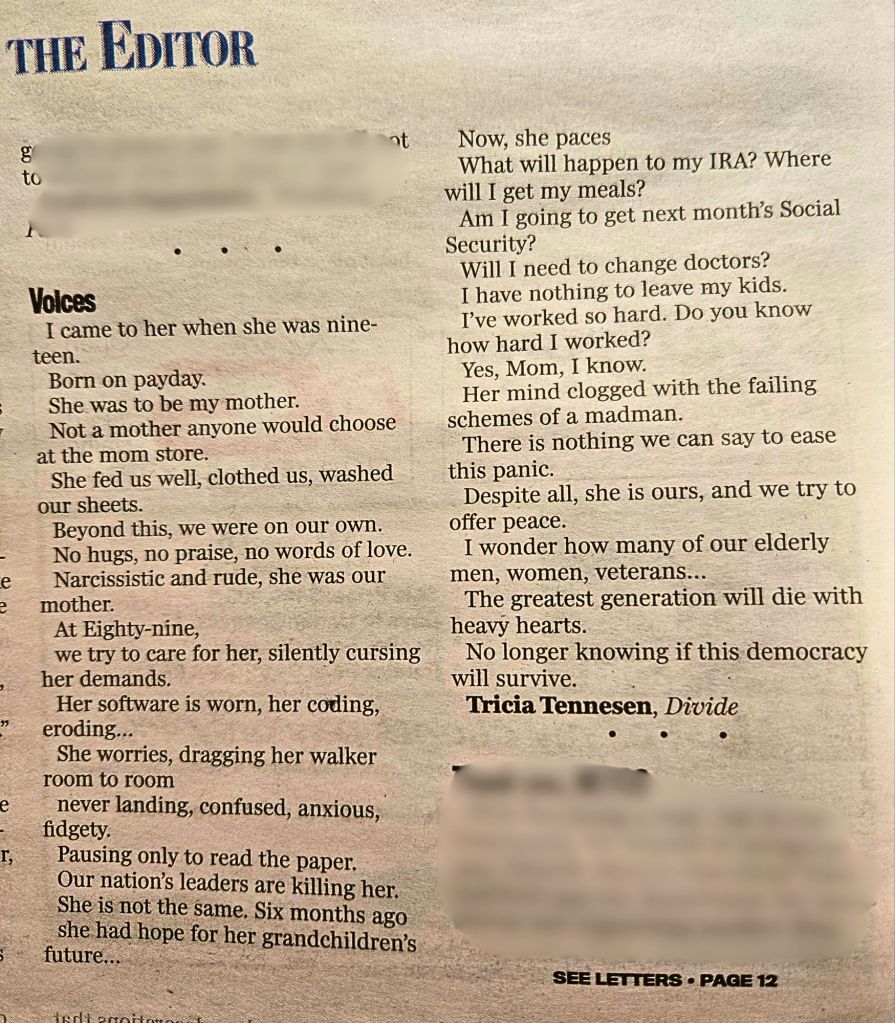
Voices
I came to her when she was nineteen.
Born on payday.
She was to be my mother.
Not a mother anyone would choose at the mom store.
She fed us well, clothed us, washed our sheets.
Beyond this, we were on our own.
No hugs, no praise, no words of love.
Narcissistic and rude, she was our mother.
At Eighty-nine,
we try to care for her, silently cursing her demands.
Her software is worn, her coding, eroding…
She worries, dragging her walker room to room
never landing, confused, anxious, fidgety.
Pausing only to read the paper.
Our nation’s leaders are killing her.
She is not the same. Six months ago she had hope for her grandchildren’s future…
Now, she paces
What will happen to my IRA? Where will I get my meals?
Am I going to get next month’s Social Security?
Will I need to change doctors?
I have nothing to leave my kids.
I’ve worked so hard. Do you know how hard I worked?
Yes, Mom, I know.
Her mind clogged with the failing schemes of a madman.
There is nothing we can say to ease this panic.
Despite all, she is ours, and we try to offer peace.
I wonder how many of our elderly men, women, veterans…
The greatest generation will die with heavy hearts.
No longer knowing if this democracy will survive.
– Tricia Tennesen
Tinder? I ‘Ardly Know ‘Er!
You Are:
- Age: 20-50
- Gender: girl or girl-adjacent
- Sexuality: optional
- Appearance: cute
- Enjoys: cuddles, reading, being picked up, talking about stuff you like while I listen and smile and play with your hair, travel, saying sweet things about me and seeing if I can top them, really good food
- Values: empathy, joy, Eliezer Yudkowsky’s Harry Potter and the Methods of Rationality, art, the outdoors
- Biggest flaw that isn’t really: likes to show off
You Might Like:
- Age: 37
- Gender: male
- Sexuality: polyamorous, straight-ish
- Appearance: 6’0″ (no, I didn’t just round up), 150 pounds (okay, I might’ve rounded that time), bald, blue eyes, as white as it gets without freckles or albinism
- My friends describe me as: Great Dane, oaf, “actual dad”
- Favorite compliment I’ve ever received: “suspiciously good-natured”
- Biggest pet peeve: my own farts
If that sounds like you (or somebody you know) HMU KK thx luv u ❤
Mal-Come Again?
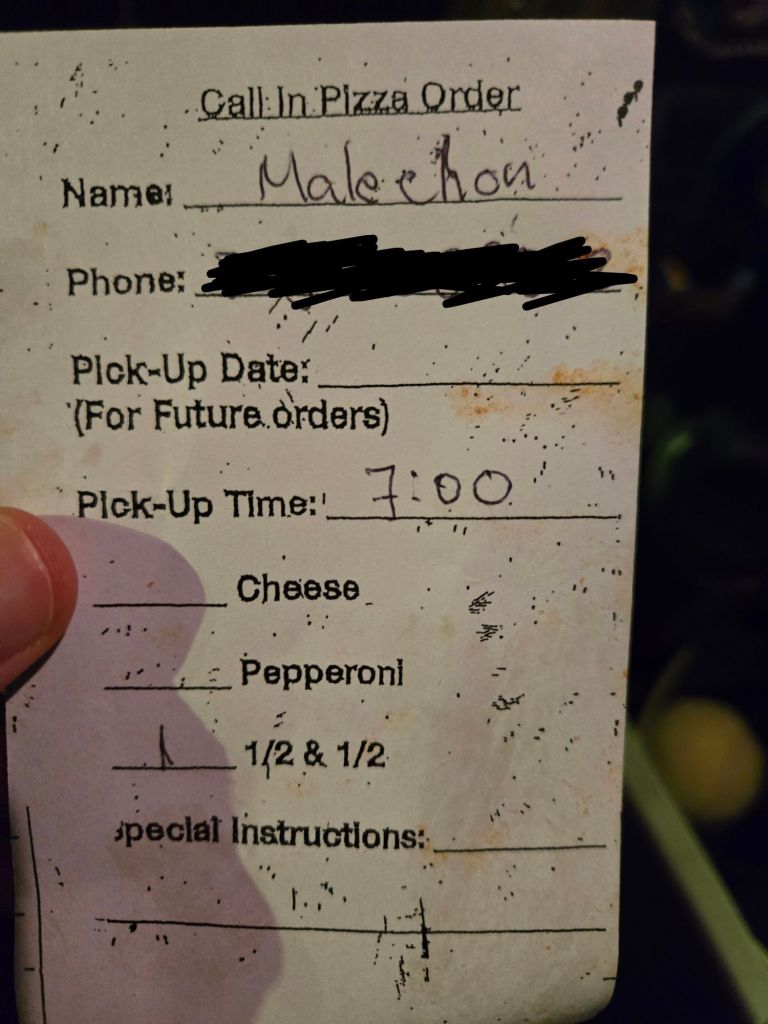
Over the years, there have been quite a few contenders for “worst misspelling of my name ever,” but this one’s just taken the top spot easily:
Filed under Microblogging
Spooky Scary Skeletons
I walked out the front door the morning after Halloween and saw this:
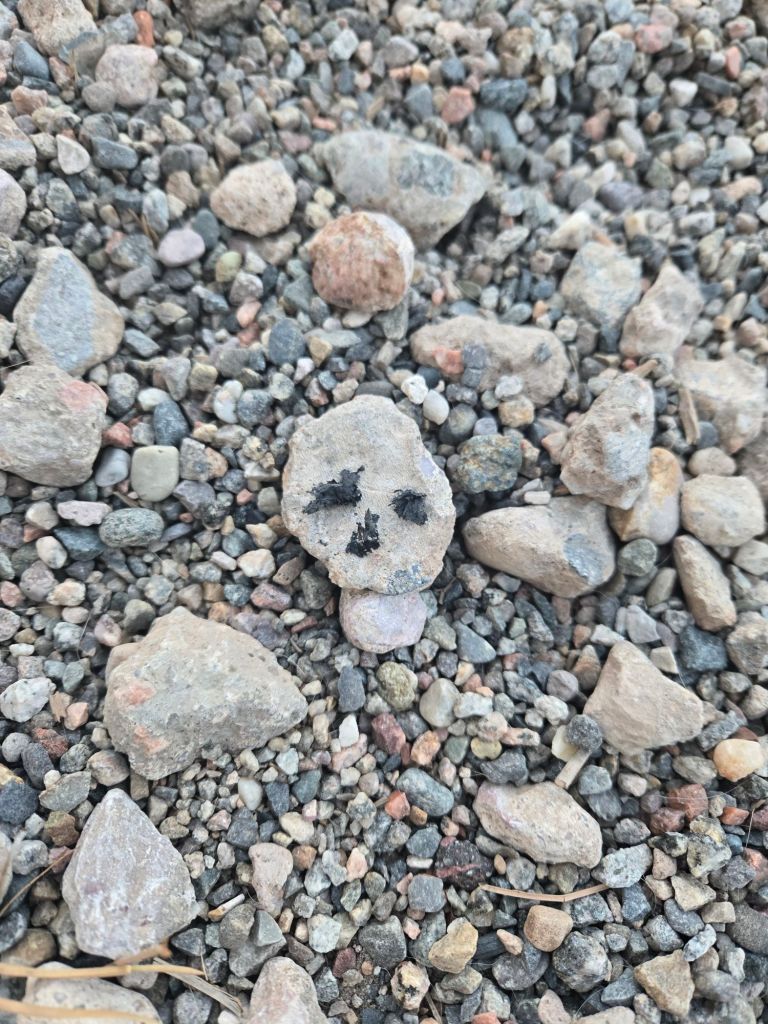
The black stuff was charred-on ash. Where did it come from? Not a clue.
Should I exorcise it or use it as a decoration?
Filed under Microblogging
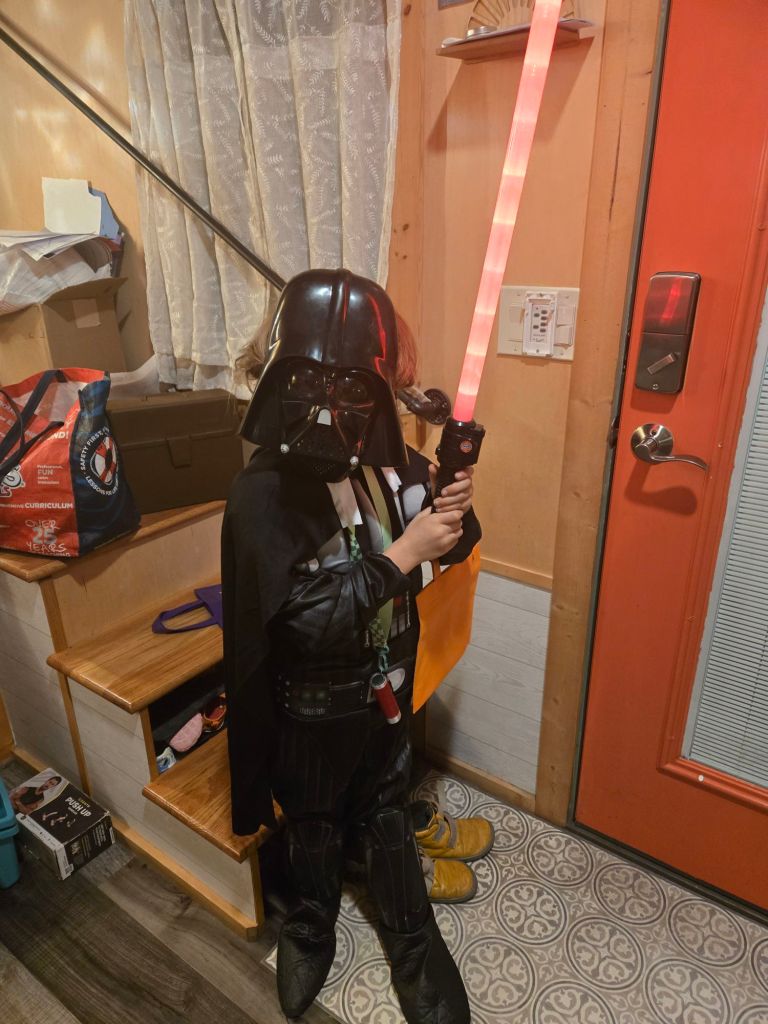
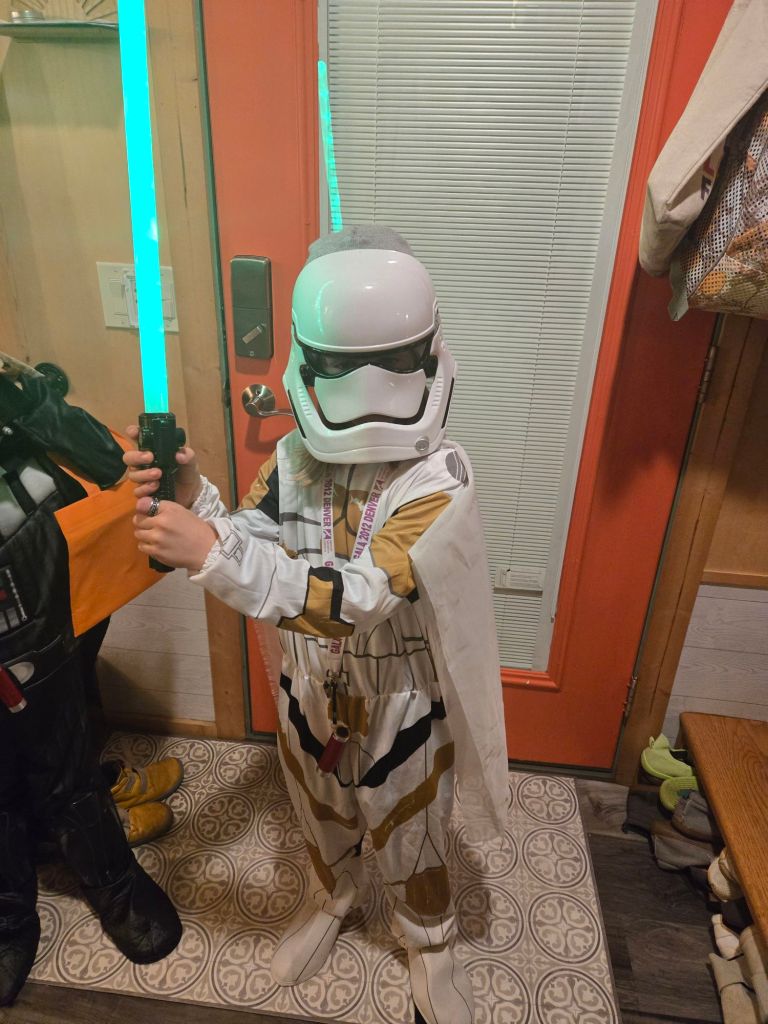
Be Yourself
I know, it’s a tough job sometimes–but if you don’t do it, who will?
Filed under Microblogging
Dreams I’ve Improved
I wrote Tuesday’s post in a bit of a rush. Looking over it, I think it suffers from a lack of concrete examples. So, here are a few instances where I’ve “revised” some of my own childhood dreams:
- The first thing I wanted to be when I grew up was an inventor. This lasted until I learned that inventors don’t just come up with ideas, they have to implement them as actual prototypes (or at least know enough engineering to make some diagrams and file a patent). Eventually, I figured out that “just coming up with ideas” is much closer to the definition of an artist, which is currently what I want to be when I grow up.
- A while after giving up (I thought) on being an inventor, I got really excited about marine biology. I’d always loved science and learning about nature, and I became particularly enthralled with cephalopods (cuttlefish are still one of my favorite animals). So I decided I’d become a marine biologist. A bit later I took some actual science classes and learned that the vast majority of doing science (as opposed to learning science, which I love) is essentially paperwork: taking notes, filling out spreadsheets and forms, doing calculations, and so on. All things I not only don’t like doing, but am also bad at. Nowadays I only do original science for fun, when I want to, and I’m content to leave the rest of it to those with the obsession to spare.
- Sometime in high school, I decided I wanted to learn how to play the piano. I really enjoyed it and ended up playing almost every chance I could get. I thought maybe I could turn it into a career, so I did some investigating–including interviewing a couple of actual professional pianists–and eventually came to the conclusion that while I wanted to keep learning and practicing, I didn’t want to devote all my free time to it. It would be a hobby, or a skill I could use in other ways (composing, for example), but not a career.
- Ever since I was a toddler playing with dolls, I’ve wanted to be a father when I grew up. I knew before I started that having a family would be more work than I expected. But even after adjusting for that fact, starting a family was still more work than I expected. It’s extremely difficult to maintain any ambitions of your own when you’re raising kids. (Fortunately, it’s still worth it.)
- I’ve had a lot of ideas for videogames and stories over the years, and I’ve finished almost none of them. Partly, this is because I’ve only begun to address some of the mental health, organizational, and motivational issues that have prevented me from finishing big projects in general (see below). However, another part of it is that many of those ideas…well…sucked. As I’ve said before, making garbage is an essential part of improving–but paradoxically, it only works if you’re trying not to make garbage. Making things you know in advance will suck doesn’t help you improve!
- I’ve previously hinted that I have ADHD. I wasn’t diagnosed until just a few years ago, and I didn’t get a therapist until this year, so I’ve only recently begun to seriously address challenges I’ve been stymied by my entire life. Dealing with mental health issues, just like taking care of your physical health, doesn’t sound ambitious or glamorous (probably because it’s something you’re expected to do, and thus considered “normal”). But obviously, not everyone takes good care of their physical health, and due to stigma and lack of support from our healthcare system the situation is even worse for mental health. And as for chronic conditions? You know, health problems that aren’t considered normal? Addressing those is treated like “catch-up”–like doing extra homework because you were sick and missed a week of school. Commendable, perhaps, but in the best case it only puts you “back to normal.” In reality, taking care of your mental and physical health is a serious, ongoing challenge, even when nothing is “wrong” with you, and your mental and physical health have ripple effects across literally everything else in your life. Staying healthy is a worthy ambition!
…I could keep going, but I think you get the idea.
What are some of the childhood dreams you’ve “revised?” Are there any you thought you’d given up on that you’re now seeing in a different light?
Filed under Essays

 In Search of Secrets
